Showing posts with label technology. Show all posts

Friday, August 15, 2008

Save the Local Bookstore

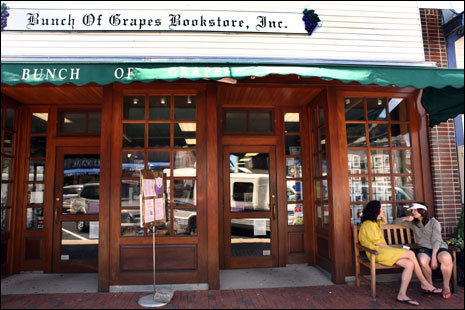
In his regular column for the Century Foundation, Peter Osnos provides commentary about several different topics as the foundation's senior fellow for media. Recently, he opined on a fire that devastated a bookstore in Vineyard Haven, Massachusetts, on Martha's Vineyard called the Bunch of Grapes. Let me rephrase that, he wasn't giving his opinion on the fire, he was lamenting the loss of yet another beloved bookstore — and offering his thoughts on ways to upgrade stores and avoid further losses.

While the Bunch of Grapes will likely be rebuilt, bookstores — even the megastores like Borders — are particularly vulnerable to the whims of the marketplace. Osnos has conducted a study of bookstores and offered his strategies. In a nutshell, it comes down to this: Customer service. People like it, and they expect it.

As Osnos explains, booksellers in stores tend to wait until the book is actually in hand before they accept cash or credit cards. So, if a book is out of stock, the store is out of luck. "Customers should never leave the store, having asked for something, without buying it, unless, of course, it can’t be found anywhere," he writes. But people willingly click their code into the Amazon Website and wait for their books to arrive.

Taking that one step further, Osnos recommends that each bookstore upgrade their Website so people can buy things online.

Good advice. So too, his final paragraph: "What these ideas have in common is the notion of a bookstore as less a repository of goods on hand than a showroom of what’s possible. The cozy familiarity of a good bookstore and the role these stores play as community assets are cherished by readers. Updated concepts of service and supply will reinforce those facts rather than diminish them. And in the meantime, for those great booksellers who cannot overcome their troubles, we will mourn your passing."

Tuesday, August 12, 2008

Danica McKellar Offers a Swift Kick in the Math

Danica McKellar is at it again, with a new book on math for girls called Kiss My Math. This time, the actress and math major helps girls cope with pre-algebra.

I suspect McKellar's pleased to have seen that girls are closing the gap with boys when it comes to math, but she's also smart enough to know that it's not enough for girls to be as good at math as boys. They both need to be able to apply this knowledge to their futures. Math and science are crucial to American success in the future. Say what you will about kids today or how "my kids are doing fine." We need to encourage all kids to do their best in math and science, because even the most basic jobs these days tend to incorporate technological skills.

Pre-algebra is necessary, as is geometry, algebra, statistics, and even a healthy dose of trigonometry won't kill kids. Personally, I loved calculus. But we can't expect everything to change right away.

Thursday, July 31, 2008

What the Kids Are Reading Now

This past weekend, the New York Times touched on a subject that I've thought about frequently: what and how are people reading in the 21st century. Like any informed American, I spend a lot of time on the Internet, reading and researching things for work and for my personal hobbies (such as reading and writing) and for topics related to family life in general. So I'm certainly not averse to people reading online.

Indeed, I applaud it; at least people are reading. And I believe that people are not afraid of writing for themselves. The explosion of blogs and social networking sites and twittering tidbits of foolishness at all hours of the day are strong anecdotal evidence that people are writing more now than they ever have.

I also know from experience that some kids are more likely than others to read books. Back when I was driving kids from schools to a YMCA for an afterschool program, there was one kid in particular (I think he was in first grade when I met him) who'd graduated from picture books to those in which only an occasional sketch was included (think Charlotte's Web or the original Winnie the Pooh books). He even remarked to a friend about how adults read books without pictures as though the concept was incredible.

Still, I can't help but see a healthy dose of pomposity in the views of those in the article who believe children can't learn without reading great books. Of course, they need first to be literate; it's a crucial life skill on par with the ability to communicate (note, I didn't say speak. Moreover, even the most affected by autism are able to communicate as long as we are willing and able to learn how to do so with them.)

I read often — great books, mediocre books, magazine articles, Web sites, academic studies — so I realize I'm not quite the average reader. But there are things I've not even thought of as readable areas that the kids described in this article devour.

Fanfiction.net, for example, is a site I've heard of but that's about it. It doesn't look familiar, so I'm not sure I've ever examined it before. But the girl in the article reads reams of Web pages there, eschewing television. Say what you will about the value of "great books," but I believe a kid who is that devoted to reading now is more likely to both read and possibly write as an adult. Good for Nadia!

Deeper in the article, there's a reference to a 2006 study that found, among other things, that the only kind of reading that related to higher academic performance was frequent novel reading, which is directly related to higher grades — especially in English. The key value of reading book-novels, academics argue, is that it allows readers to mentally chew over the ideas proffered in the works. Indeed that's true, and when people have read books in common, this spurs conversation and further reflection, which embeds the ideas deeper into a child's or adult's brain. This is where the Web is perfect!

So, if I can suggest anything in this post, it would be to encourage everyone to read — novels and short stories, works of nonfiction, newspapers, Web sites, the NYT article from which this post is inspired — and then talk about these things with other people. Reading fosters intelligent discussion. Conversation builds community. Strong community bonds can instill more democratic governance. There's a slogan in the waiting: Literacy Builds Democracy. I think both Republicans and Democrats can support that.

Thursday, September 06, 2007

Flying Cars, Teleportation, and eBooks

I'm a traditionalist, so the idea of reading a book on a small computer screen has no appeal to me. But that doesn't mean people won't test whether there's a market for an eBook reader. This New York Times story discusses the prospects of new products coming from Google and Amazon -- not actually saying much about the products themselves, but the prospects of them. For me, I love the light weight and flexibility of a regular book. I don't need to add any more weight or electricity into my life. But this article is worth at least taking a look at to keep up with where the technology is going -- whether it gets there or not.