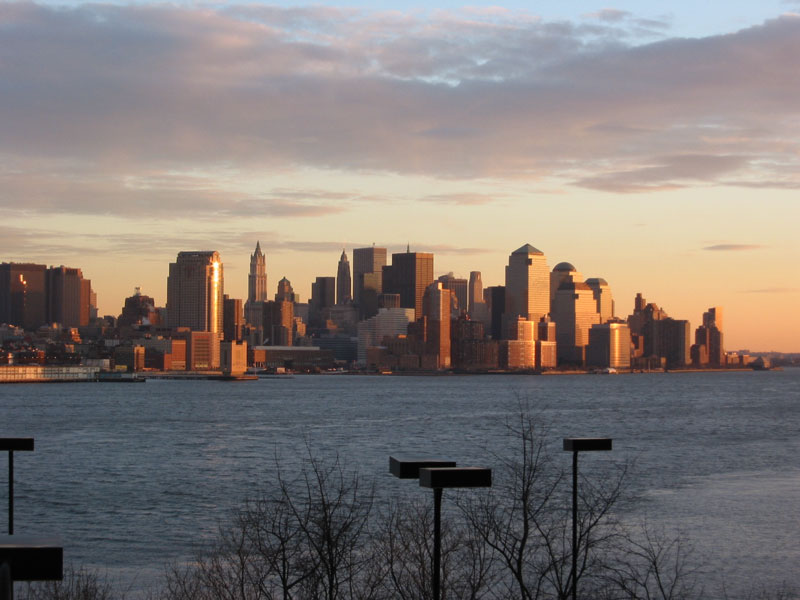
Where I live, the events of 9/11 were not just images on a television or messages of heartfelt sadness. They were those things, of course, but they were also a motorcade of funerals, a stream of floral arrangements, a vital Thanksgiving meal months later. That day led to random moments of pain and sadness when otherwise meaningless things were noticed to be missing. And it also led to phone calls from people whose voices had almost been forgotten, calling..."just because, well, it's been a while, you know?" and we knew.
For me, 9/11 was highly personal for reasons I won't get into here. But it changed things in me about my writing, about what I wanted to accomplish and be remembered for: Writers write.
Those who know me personally or even merely from random lines in places like AgentQuery Connect or From the Write Angle or via Twitter probably get a sense that I like to joke around. Often, I joke because I take most of life so seriously — sometimes too seriously, perhaps. After 9/11 I took my manuscript very seriously. It had been mostly notes before that day. Maybe a few dozen pages of tripe were written. I don't think any of it survives except for its setting. My story took place in Hoboken, New Jersey, which is just across the river from New York City. The attacks were a point of demarcation unlike any other in my lifetime and I needed to decide when my story took place.
I decided that it was to be a year in the life of a family: From 9/10/00 to 9/10/01. I wrote nightly for months and most of that ended up on the cutting room floor, so to speak. It was my first serious attempt at a novel, and I made the mistakes that most writers make on such efforts. Too much back story, too many details that don't matter. I ended up putting it aside for months and working on other things. Short stories, mostly. A lot of freelance assignments. Some of which I'm proud of.
Eventually, I went back to my story, took it apart piece by piece, and started to build again. Perhaps too subtly, I wove 9/11 into the manuscript. It's there, but the story takes place before the events, so it must be done with care. I've had people tell me to change the date of the story or to make it more apparent. And I still think about it. The manuscript still has elements I'm uncertain about, and I've put it aside several times to work on other projects and let my mind work through those elements and help me decide if they're flaws or just need a bit more polishing.
By the time the polishing is done and it goes off to agents, I suspect I'll have come close to finishing another manuscript and several other short stories and a bunch more articles I'm proud of. But this story is one that will be with me forever, whether it gets published or not.
In a sense, it will be part of my personal 9/11 legacy. If nothing else, I have that.
To live like an elephant is not only to never forget, but to do one's best to endure. The Elephant's Bookshelf is a place where you can share cherished books and stories -- old and new -- with other readers, writers, and elephants. Post your thoughts on writers, reading, and writing.
Sunday, September 11, 2011
Tuesday, August 16, 2011
Chickens, Eggs, and the Coop
A question has popped into my mind lately. It's one of those odd things that doesn't have a right answer but depends entirely upon individuals and their circumstances. But the question is this: Which comes first, the title of your manuscript, the story or plot, the characters, the setting, or is it something else entirely?
I've been writing short stories lately, and on a couple of them the title came first. But I found that as I was writing, the title stopped mattering, so now their names are changing. I imagine they'll change again as I edit the stories.
I suppose the question isn't far removed from my most recent post, but I'd love to hear what your experiences are. Do you come up with a title first? Do you see characters and work to find a story for them? Do you have a story idea and see where things go? Do you just write by the seat of your pants and let fly with whatever comes to mind? (I know many people like that. Works for them!)
What works for you?
I've been writing short stories lately, and on a couple of them the title came first. But I found that as I was writing, the title stopped mattering, so now their names are changing. I imagine they'll change again as I edit the stories.
I suppose the question isn't far removed from my most recent post, but I'd love to hear what your experiences are. Do you come up with a title first? Do you see characters and work to find a story for them? Do you have a story idea and see where things go? Do you just write by the seat of your pants and let fly with whatever comes to mind? (I know many people like that. Works for them!)
What works for you?
Labels:
characterization,
planning,
plot,
titles,
writing
Tuesday, August 02, 2011
What's in a Name
Over at AgentQuery Connect, there's a challenge going on: Post a title to see what readers think. Will they pull it off the shelf? Or maybe you can think of it as, if you were an agent and saw this title, would you be intrigued?
There have been many wonderful titles and a few that make you scratch your head — which is better than those that leave you simply passing by and looking for a different title. For writers who've never had a book published (and, yes, that rather large group includes me), it's a good lesson to engage in as we attempt to write a manuscript that attracts the eyeballs of people who pay for books (also a rather large group, thank goodness!)
But how realistic is it? Do you buy a book purely based on its title? Does the title have enough gravitational pull to attract your arm in order to slide the book off the shelf? Maybe, but I'm not 100 percent convinced. I'm one of those readers who loves finding new writers, but I tend to have them recommended to me by other readers. And when they do so, it's the writer's story, not the title, that I'm looking to fall in love with. That's how I met the works of Michael Chabon, Christopher Moore, and John Connolly — three writers whose individual styles and voices all appeal to the reader in me.
Had I been looking for adult books to read in the early 1970s (I was still engrossed in the Richard Scarry and Dr. Seuss collections at that point), would I have picked up Carrie? Probably not. What about Moby Dick? What about that title screams white whale or obsession? Rudyard Kipling's The Elephant's Child? Definitely, but I'm an elephant guy.
Mind you, I am not saying titles are unimportant. Perish the thought! Because people do skim the shelves and find writers they didn't know. A title can attract someone's attention. It's the first step. The hopeful reader slides the book out a little bit. Is the cover art appealing? Yes, off the shelf it comes! Perhaps she stares at the cover a second more, hoping the author's name or the title suddenly ring a bell. If not, the next milestone is turning the book over and reading that back blurb. Remember all that work that went into crafting your query? You have even less time to attract the reader on the back cover than you did when you were trying to ensnare an agent's interest. I've stopped reading before the first sentence was done. Back to the shelf with you!
Perhaps the book has an inside flap. Bonus! Those are great ways to gain a reader's confidence. I've bought books based on the inside flap. It contained the bones of a story. But that half-ream of dead trees in between the covers needed to be filled with flesh and blood, sweaty excitement and tangy irony if the writer wanted me to remember her name and inquire about another tryst.
You know when a title has mattered to me? After I was done. Has this happened to you? Have you finished a book and found yourself wondering not about what would happen next to those characters you just fell in love with, but rather about why the author (or agent, or editor, or marketing department, or publisher) decided to call it That. To me, that's when a title's problems come to the forefront.
What about you? Do you buy a book based on its title?
There have been many wonderful titles and a few that make you scratch your head — which is better than those that leave you simply passing by and looking for a different title. For writers who've never had a book published (and, yes, that rather large group includes me), it's a good lesson to engage in as we attempt to write a manuscript that attracts the eyeballs of people who pay for books (also a rather large group, thank goodness!)
But how realistic is it? Do you buy a book purely based on its title? Does the title have enough gravitational pull to attract your arm in order to slide the book off the shelf? Maybe, but I'm not 100 percent convinced. I'm one of those readers who loves finding new writers, but I tend to have them recommended to me by other readers. And when they do so, it's the writer's story, not the title, that I'm looking to fall in love with. That's how I met the works of Michael Chabon, Christopher Moore, and John Connolly — three writers whose individual styles and voices all appeal to the reader in me.
Had I been looking for adult books to read in the early 1970s (I was still engrossed in the Richard Scarry and Dr. Seuss collections at that point), would I have picked up Carrie? Probably not. What about Moby Dick? What about that title screams white whale or obsession? Rudyard Kipling's The Elephant's Child? Definitely, but I'm an elephant guy.
Mind you, I am not saying titles are unimportant. Perish the thought! Because people do skim the shelves and find writers they didn't know. A title can attract someone's attention. It's the first step. The hopeful reader slides the book out a little bit. Is the cover art appealing? Yes, off the shelf it comes! Perhaps she stares at the cover a second more, hoping the author's name or the title suddenly ring a bell. If not, the next milestone is turning the book over and reading that back blurb. Remember all that work that went into crafting your query? You have even less time to attract the reader on the back cover than you did when you were trying to ensnare an agent's interest. I've stopped reading before the first sentence was done. Back to the shelf with you!
Perhaps the book has an inside flap. Bonus! Those are great ways to gain a reader's confidence. I've bought books based on the inside flap. It contained the bones of a story. But that half-ream of dead trees in between the covers needed to be filled with flesh and blood, sweaty excitement and tangy irony if the writer wanted me to remember her name and inquire about another tryst.
You know when a title has mattered to me? After I was done. Has this happened to you? Have you finished a book and found yourself wondering not about what would happen next to those characters you just fell in love with, but rather about why the author (or agent, or editor, or marketing department, or publisher) decided to call it That. To me, that's when a title's problems come to the forefront.
What about you? Do you buy a book based on its title?
Monday, July 18, 2011
Familiar Ground
Sometimes I go through phases. A year ago, I swept through the John Connolly books again, and not long before that I was into Christopher Moore for a second go-round. I can always crack open Tolkein, but after you've read it a dozen times, you start to wonder why you want to make that type of time investment again; the pleasure of reading is very much still there, but ... well, sometimes you crave something different.
So I've decided to dive into short stories again. I've been getting into the One Story items that I don't always have time for when they arrive. The joy of short stories is, even if they're not great, they're not so long that you feel like you wasted your time. And when they're really good, you feel like you've discovered a new element, seen a shooting star, or met the person of your dreams. You're willing to keep learning more about that writer. Of course, sometimes when you do so, you find out that the element was discovered long ago, or it was just space junk, or maybe she isn't nearly as pretty as you thought in the dark bar.
So, what do you do when you're not sure what to read next?
Subscribe to:
Posts (Atom)


