Showing posts with label books. Show all posts

Tuesday, October 16, 2012

Q&A: Poet Caroline Hagood

In my meanderings through life, I often catch myself getting distracted by unexpected beauty and wit, especially when I step my toes into the puddles of joy that are writers' blogs.

One writer I discovered quite by accident, Caroline Hagood, has graced the electronic pages of this blog, back when she was still blogging at Culture Sandwich, where she posted poems, book reviews, interviews, and thoughts on art and culture in general. These days, she’s in a Ph.D. program at Fordham University, but she recently had her first book of poetry, Lunatic Speaks published by FutureCycle Press. As the Elephant’s Bookshelf blog begins its new incarnation as a brief rest stop for writers and readers of all stripes, I thought it fitting to allow a poet to deliver the invocation.

EB: How long have you been writing poetry?

CH: I've "written" since I was a dyslexic kid who couldn't read or write for years after everyone else, and my mom was kind and patient enough to write down my early "songs" that only she and my dad could possibly love.

EB: Do you follow a consistent process in your work or do you vary things as the ideas come?

CH: I try to type things into my electronic graveyard--what I call my computer file that's longer than I should ever share, which contains many unformed poem thoughts--every day. Then I try to form a finished poem out of this wreckage once a week. If anyone ever finds this password-protected document, I will feel very embarrassed and very sorry for them.

EB: Much of your work comes across as very personal. Do you fear you expose too much of yourself in your poetry or is there still a layer or two between you and your audience?

CH: There are definitely some layers there. I think people often assume that every (especially first person) poem is autobiographical, but, as others far sharper than I have noted, although there is always some kind of truth there, it just may not be conventionally factual. It would be like reading someone's dreams and thinking they all happened to the dreamer. For instance, although I wrote about it in my collection, I have never received a letter from a dinosaur, although I am very open to it.

And, yes, I fear that I expose too much of myself every day. My whole life is basically one big emotional risk, but I'm usually glad I took it.

EB: Thanks so much for sharing with us, Caroline.

CH: My pleasure.


Tuesday, February 10, 2009

Nonfiction Writers Wanted!

If you're a writer of nonfiction who's looking to get his book idea into shape for agents, you might want to visit and join AgentQuery Connect, where a nonfiction discussion group was recently established. For those of you who are familiar with AQC, you probably know that it's primarily populated with fiction writers, but nonfiction remains the biggest segment of the publishing world and AQC recognizes that.

I don't work for AgentQuery, I'm simply an active member of that community, and while I'm there to gain insight into getting my fiction published, I'm a working journalist with ideas for several nonfiction works, so I'll be an active participant in that area too.

There simply haven't been many participants yet, so come on in and join on the ground floor of an active online community of writers. I'm sure you'll like it.

Monday, December 29, 2008

Antarctic Winds

I have begun reading The Entire Earth and Sky by Leslie Carol Roberts, which I received for Christmas. Though I'm only a couple dozen pages in, I already am thrilled at what it is showing me. Of course, I have selfish reasons: I'm in the midst of writing my Antarctic novel. And I suppose it helps that winter has descended upon us and given me a nasty cold to boot. But Roberts includes the tasty human details that I am looking for to make Antarctica seem real to readers.

While I might edit things a little differently than her editors did, her voice is there, and that is essential (as it is in any book – fiction or non-fiction.) Indeed, I might even reach out to Ms. Roberts to see if I can learn more from her about Antarctica, though I'll wait until after I've finished her book.

In the meantime, I will listen to the winter wind, feel grateful for my heavy coat, my scarf, hat, and gloves, and imagine my characters in their fictional Antarctica, perhaps catching the music of Icestock at New Years. I wonder if there's live streaming... Will wonders never cease?

Sunday, September 28, 2008

Thanks for Voting!

Thanks to those who voted in the first poll on the Elephant's Bookshelf. Looks like those who come here are probably readers or enjoyably sarcastic (yeah, as if I can extrapolate anything from four votes, but I do appreciate them all).

As you might expect, the polls will be related to books, reading, and writing. If you have any that you'd like to suggest, feel free by emailing me at elephantsbookshelf@gmail.com or by posting a comment here.

Friday, August 29, 2008

A Few of My Favorite Things

Just in time for the long holiday weekend, there's a nice little piece in the Washington Post about one's favorite gift books. I've actually never thought about such a qualification before, so I'll need some time before I include my own favorite gift books.

One that I know will be there, however, is John Irving's The World According to Garp. If you read my other recent post about favorite books, you know that I hold that tale dear to my heart. But how I first discovered the book is a different story. I don't know if I'd seen the movie or not. But a high school friend and I exchanged items: she got my tape of Pink Floyd's Umma Gumma, and I took home Garp. I don't think it was meant to be a permanent exchange (though I eventually bought the Umma Gumma CD to replace what had been passed along), so I read the book right away despite having the usual array of high school classes.

I loved the characters, and I eventually rented the VHS (way back in the 1980s and even into the 1990s, there were things called video tapes, kids...) of the movie and fell in love with that too.

Anyway, I'll need to think about favorite gift books. But while I do, I invite you all to share your favorites. You don't need to share five; any number will do. Just say what it is and, if you'd like, why you love it. Or email it to elephantsbookshelf@gmail.com if you'd prefer to stay anonymous online.

Tuesday, August 19, 2008

Vote for Your Favorite Books!


The Atlanta Journal-Constitution is looking for a few good readers.

Specifically, they're asking readers to vote for their favorite page-turners, in anticipation of the Decatur book festival. From what I can tell, they don't care whether you live in Atlanta or Atlantis, so if you love books and have an opinion, I think you should feel free to let them know what you think are the best.

Personally, I think they'll have a lot of readers from their local area voting too, since the AJC used to have a highly regarded literary section and the city has traditionally been among the most literate in the country. (Props to you, Atlanta! And this from a Mets fan.)

And if you'd care to share your favorites here on the Elephant's Bookshelf, I'd love to know what you're reading. You'll find mine below very soon.

[Added later in day]
Ok, here's my list of favorites, though I honestly have too many favorites to limit to just five. These are the five that come most quickly to mind.

1) The World According to Garp – John Irving
2) The Lord of the Rings trilogy – J.R.R. Tolkien
3) To Kill a Mockingbird – Harper Lee
4) The Amazing Adventures of Kavalier & Clay – Michael Chabon
5) Something Wicked This Way Comes – Ray Bradbury

Other books I would keep on the proverbial desert island:
Cat's Cradle – Kurt Vonnegut
A Prayer for Owen Meany – John Irving
Franny & Zooey – J.D. Salinger
The Book of Lost Things – John Connolly
The Lust of the Eyes – Matt Sinclair
Practical Demonkeeping – Christopher Moore

{Yes, I tucked my own unpublished novel in there. Why not? It's my island!}

Friday, August 15, 2008

Save the Local Bookstore

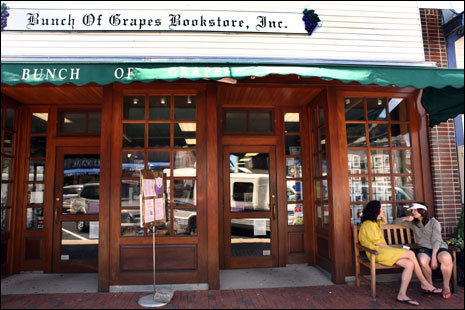
In his regular column for the Century Foundation, Peter Osnos provides commentary about several different topics as the foundation's senior fellow for media. Recently, he opined on a fire that devastated a bookstore in Vineyard Haven, Massachusetts, on Martha's Vineyard called the Bunch of Grapes. Let me rephrase that, he wasn't giving his opinion on the fire, he was lamenting the loss of yet another beloved bookstore — and offering his thoughts on ways to upgrade stores and avoid further losses.

While the Bunch of Grapes will likely be rebuilt, bookstores — even the megastores like Borders — are particularly vulnerable to the whims of the marketplace. Osnos has conducted a study of bookstores and offered his strategies. In a nutshell, it comes down to this: Customer service. People like it, and they expect it.

As Osnos explains, booksellers in stores tend to wait until the book is actually in hand before they accept cash or credit cards. So, if a book is out of stock, the store is out of luck. "Customers should never leave the store, having asked for something, without buying it, unless, of course, it can’t be found anywhere," he writes. But people willingly click their code into the Amazon Website and wait for their books to arrive.

Taking that one step further, Osnos recommends that each bookstore upgrade their Website so people can buy things online.

Good advice. So too, his final paragraph: "What these ideas have in common is the notion of a bookstore as less a repository of goods on hand than a showroom of what’s possible. The cozy familiarity of a good bookstore and the role these stores play as community assets are cherished by readers. Updated concepts of service and supply will reinforce those facts rather than diminish them. And in the meantime, for those great booksellers who cannot overcome their troubles, we will mourn your passing."

Thursday, July 31, 2008

What the Kids Are Reading Now

This past weekend, the New York Times touched on a subject that I've thought about frequently: what and how are people reading in the 21st century. Like any informed American, I spend a lot of time on the Internet, reading and researching things for work and for my personal hobbies (such as reading and writing) and for topics related to family life in general. So I'm certainly not averse to people reading online.

Indeed, I applaud it; at least people are reading. And I believe that people are not afraid of writing for themselves. The explosion of blogs and social networking sites and twittering tidbits of foolishness at all hours of the day are strong anecdotal evidence that people are writing more now than they ever have.

I also know from experience that some kids are more likely than others to read books. Back when I was driving kids from schools to a YMCA for an afterschool program, there was one kid in particular (I think he was in first grade when I met him) who'd graduated from picture books to those in which only an occasional sketch was included (think Charlotte's Web or the original Winnie the Pooh books). He even remarked to a friend about how adults read books without pictures as though the concept was incredible.

Still, I can't help but see a healthy dose of pomposity in the views of those in the article who believe children can't learn without reading great books. Of course, they need first to be literate; it's a crucial life skill on par with the ability to communicate (note, I didn't say speak. Moreover, even the most affected by autism are able to communicate as long as we are willing and able to learn how to do so with them.)

I read often — great books, mediocre books, magazine articles, Web sites, academic studies — so I realize I'm not quite the average reader. But there are things I've not even thought of as readable areas that the kids described in this article devour.

Fanfiction.net, for example, is a site I've heard of but that's about it. It doesn't look familiar, so I'm not sure I've ever examined it before. But the girl in the article reads reams of Web pages there, eschewing television. Say what you will about the value of "great books," but I believe a kid who is that devoted to reading now is more likely to both read and possibly write as an adult. Good for Nadia!

Deeper in the article, there's a reference to a 2006 study that found, among other things, that the only kind of reading that related to higher academic performance was frequent novel reading, which is directly related to higher grades — especially in English. The key value of reading book-novels, academics argue, is that it allows readers to mentally chew over the ideas proffered in the works. Indeed that's true, and when people have read books in common, this spurs conversation and further reflection, which embeds the ideas deeper into a child's or adult's brain. This is where the Web is perfect!

So, if I can suggest anything in this post, it would be to encourage everyone to read — novels and short stories, works of nonfiction, newspapers, Web sites, the NYT article from which this post is inspired — and then talk about these things with other people. Reading fosters intelligent discussion. Conversation builds community. Strong community bonds can instill more democratic governance. There's a slogan in the waiting: Literacy Builds Democracy. I think both Republicans and Democrats can support that.

Tuesday, June 17, 2008

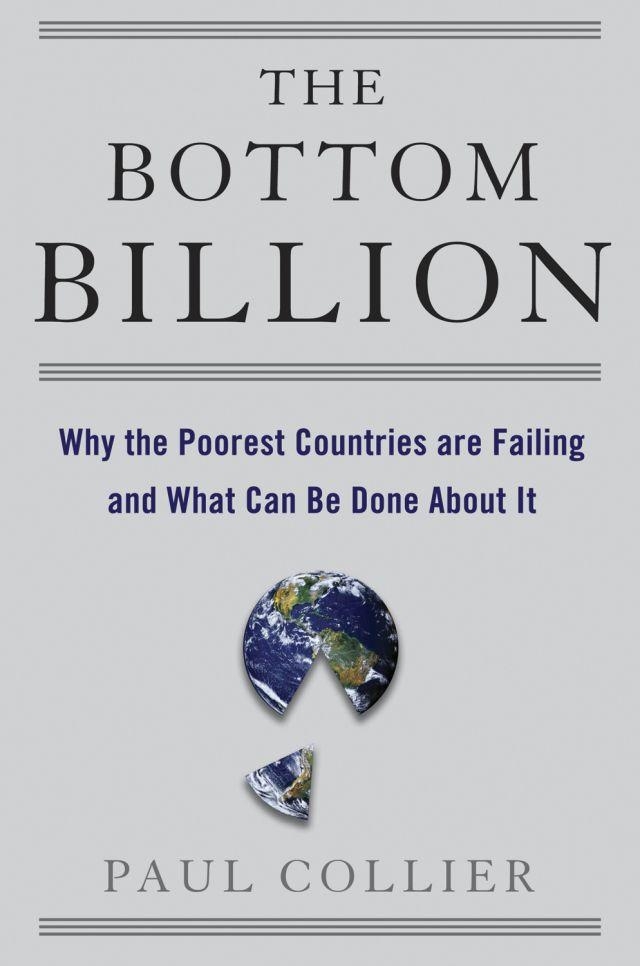
Book Review: The Bottom Billion, by Paul Collier

This review, which I wrote, appeared previously on a different Web site. If you want the link to the original, please leave a comment below and I will contact you directly. If you want me to view it without publishing your name, I'll gladly do that. I keep no list of readers, so I won't sell it anywhere.

During an International Women's Day event at the United Nations in 2007, former UN undersecretary general for communications and public information Shashi Tharoor told the audience that the way to change the world could be summed up in two words: "Educate girls."

The beauty of Tharoor's advice is that it is easily articulated. And no doubt it would go a long way toward solving many of the most persistent problems in the world today if it were widely adopted. But as former World Bank economist Paul Collier explains in his new book The Bottom Billion, the plight of the world's most impoverished people is not simply a matter of education. Indeed, while Collier shares Tharoor's enthusiasm for educating girls, he is far more concerned about the rate of development in the world's poorest nations.

In the book, Collier argues that the challenge for mankind going forward is painfully stark. "By 2050," he writes, "the development gulf will no longer be between a rich billion in the most developed countries and five billion in the developing countries; rather, it will be between the trapped billion and the rest of mankind."

Why? After noting that the situation has changed dramatically over the last four decades, Collier explains that the countries whose populations make up the bottom billion are distinctive not only in their poverty but in their inability to develop economically. According to Collier, the decline of the countries where the world's poorest people live is not just relative; it is absolute. "Many of these countries are not just falling behind," he writes, "they are falling apart."

Collier doesn't subscribe to the idea that poverty is cultural or intractable — if either were the case, he notes, India and China would not be rising economic powers. Instead, he and his team of international researchers examine the traps — lack of natural resources, corruption and bad governance, proximity to bad neighbors — that ensnare poor countries in destructive cycles of conflict and violence. And should a poor country somehow manage to escape those traps, it faces the additional challenge of trying to compete in a global economy that is not as welcoming to new entrants as it was during the 1980s.

Indeed, Collier's attempts to strike a hopeful note often ring hollow, and his analysis throughout the book is tinged with pessimism. Like other economists, he notes that international aid has been largely ineffective in resolving the problems of poor countries. And while he concedes that rock stars and celebrities have helped to bring needed attention to the plight of the bottom billion, he is dismissive of most celebrities' grasp of the complex economic and political realities that undermine poor countries' development prospects.

What is needed, Collier explains, is a range of policy instruments that encourage countries to take steps toward change, including policies that enable African countries to export their goods and place them on a "productivity escalator." Yet, many of the tools traditionally used to help the world's poor are rendered ineffective by bureaucratic inertia and/or infighting. "Our support for change can be decisive," Collier writes. "But we will need not just a more intelligent approach to aid but complementary actions using instruments that have not conventionally been part of the development armory: trade policies, security strategies, changes in our laws, and new international charters."

Not even democratic elections offer much hope. Somewhat surprisingly, Collier's team of researchers found that elections neither help nor hinder a country's development prospects. Instead, they seem to shift the risks that continually loom as a threat to those prospects. "In the year before an election, the risk of renewed conflict goes sharply down [while] in the year after an election the risk goes sharply up," he writes. "Elections may be desirable for all sorts of reasons," he adds, "but they do not seem to make the society safer."

So, too, the role of nongovernmental organizations. In the book, Collier relates a story about Christian Aid, a respected British charity, which launched an anti-free-trade ad campaign in which a capitalist was portrayed as a pig sitting atop a peasant. No fan of Marx, Collier writes that the message was "grotesquely" wrong and that "Trade policy is the area of economics least well understood by the NGO world."

In fact, of all the tools employed to address the problem of conflict traps in poor countries, Collier is most skeptical of trade, especially when applied to post-conflict situations. In such situations, he argues, key basic services should be delivered by an independent service authority, which would enable donor governments to coordinate their response without overloading a weak post-conflict government. Even then, however, the key to success is identifying exceptional homegrown leadership that is able to foster reconciliation while avoiding the trap of corruption.

In the end, Collier takes politicians on both the right and left to task for tolerating the plight of the world's bottom billion as long they have. "If nothing is done about [it]," he warns, "this group will gradually diverge from the rest of the world economy...forming a ghetto of misery and discontent."
And that would be a disaster for all of us.

Saturday, May 24, 2008

Confessions of a Beer Guy

Though I've not been partaking of the grain much this holiday weekend, I'm an unabashed beer guy. I've got the gut to prove it (I've paid good money for this, so I'm not going to be ashamed of it — though I wouldn't mind being in better shape). While I have no problem with the occasional glass of wine — usually white when I have it — I'm unable to fully appreciate the nuance and subtlety of a fine wine; I simply don't have that training.

So when I saw a press release discussing a book on the differences between beer and wine, I knew I had to comment on it.

The book is called Grape vs. Grain: A Historical, Technological, and Social Comparison of Wine and Beer, and it's written by an academic of sorts -- Charles Bamforth, head of the brewing program at the University of California, Davis, but I get the impression that his book is at least worth picking up for a look see, even if you don't buy it.

The 224-page book includes social commentary on beer and wine, and comparisons of their histories, production techniques, types and styles, healthfulness, and future outlooks.

This Memorial Day Weekend, I think I'll be more likely to do my own personal experimenting with beer than read about other people's social commentary about it.

Here's my social commentary: Crack open a cold one and have a wonderful Memorial Day!

Wednesday, April 23, 2008

Alice Munro and the Know-It-All

I've been in a reading slowdown. I won't call it a slump; slumps are for aging first basemen. I know exactly what has caused my slowdown: slow moving or long books.

And I've been enjoying every turtle-paced moment of it.

Right around the beginning of April, I began reading Alice Munro's collection of stories Hateship, Friendship, Courtship, Loveship, Marriage. Each of these stories is exquisitely paced and developed; every character has depth and meaning. I could read it again three times and discover new traits in everyone at each passing. This Munro dame knows how to scribble. A book like that should not be consumed with a deadline in mind (Must read a book a week. Must read a book a weeek...) No, if I were to teach a course on writing, I'd want to invest lots of time in the works of Munro exploring how she animates these characters so well.

Perhaps it's because it was the last story, but "The Bear Came Over the Mountain" is especially memorable, and I say that not to be ironic; it involves a woman who becomes demented. (I don't think they specifically say it's Alzheimer's disease, but it sounds like it.) And "Floating Bridge" provides some fairly obvious symbolism, but remains a poignant story of a woman dealing with cancer.

Once I completed that book, I dove into A.J. Jacobs' The Know-It-All, and have been pleasantly suprised. This is essentially a memoir by a journalist who fears he's begun to lose the mental sharpness he had when he was younger, so he decides to read the entire Encyclopedia Britannica. His quest, he claims, is to become the "smartest" person on earth. Of course, within the first twenty-five pages there begins the inevitable discussion of the difference between knowledge and intelligence. Indeed, it is a theme that continues throughout the book.

That was one of the most surprising aspects of this book, actually: there are themes. It is as much a description of a middle-aged man who desperately wants to become a father and to pass along a legacy of a love for knowledge -- which he received from his father -- as it is a recitation of what he's learned. And the book is quite amusing at times. I've had several instances where I've chuckled loudly on the train. You don't get too many of those moments with Alice Munro.

I expect I'll finish The Know-It-All this week, and I've not decided what's next. I may return to John Connelly or pick up something else. I have a Peter Carey novel waiting to be cracked. But Munro and Jacobs have reminded me why I love reading in the first place: Books take me away from the mundane and can make me laugh. I don't need an iPod.

Tuesday, April 22, 2008

Celebrate World Book Day

Got a book? Good. I hope you're reading regularly. To a certain extent, it doesn't really matter what you're reading, as long as you read. Because not everyone can.

Today is World Book Day. [Author's note: Apparently I'm wrong; World Book Day was on March 6 -- though I've seen it posted as 4/23 also. Regardless, I'd forgotten about it until after seeing a Google blog link and writing about it. But I still believe in the importance of writing.] Unlike some Hallmark Holidays, World Book Day can actually do something more valuable than sell cards. It's designed to promote literacy. The Google blog page that I linked to above contains a link to its Literacy Project, where it promotes a few smaller projects.

That's all well and good. For those who can already read, however, I want to say, "Keep reading." It's good for you. Allow your mind to expand in ways that illicit drugs never will touch. Develop your imagination.

How's this as a way to promote literacy: literacy leads to exploration, exploration leads to imagination. Imagination leads to having a mind that can comprehend wondrous pleasures. ... Literacy leads to better sex. QED.

Tuesday, March 04, 2008

Tag, You're It!


Back from vacation and after digging through the first strata of emails, I received this today: an announcement that Barnes & Noble has launched a video magazine series called "Barnes & Noble Tagged!"

Though I've peeked at its first couple of minutes, I've not watched enough to say it's well done or not, but my initial impression is the image quality is good, the volume level may be a little low (which means you have to remember to turn your speakers down later or you may blast something later), and the books are decidedly mainstream. I intend to watch it more thoroughly, and I encourage book lovers and writers to give it a shot. We all need more ways to promote reading and to promote writers of all levels.

Personally, I'd like to see less about Jodi Picoult, who has done well to establish an audience, and more about excellent writers who remain relatively or completely unknown. Of course, I have a vested interest in that, since I hope to be one of those "relatively unknown" excellent writers who claws his way to everyone's consciousness and sells boxes full of books.

[And for those of you who asked: No, I didn't finish all the revisions this past week, which I regard as a blessing. It means that I'm putting in the appropriate amount of time to make sure I do it right (these weren't merely correcting a couple typos; it's a matter of weaving things in and tightening up loose strands), and that I actually relaxed a bit during the vacation. I needed that! And thanks for asking.]

Sunday, January 27, 2008

Fantasyland by Sam Walker


I just finished reading Fantasyland by Sam Walker, and as a result I'm starting to plan for the upcoming fantasy baseball season. Any baseball fan will enjoy it, not because of the Rotisserie baseball action that it describes but because it is funny and uplifting and discloses the heroism present in ordinary people.

Walker is a writer for the Wall Street Journal and he had never played Rotisserie baseball before. But he was able to finagle his way into the Tout Wars expert league, which is widely regarded as one of the toughest leagues out there. For those who aren't aware, fantasy baseball has become a billion-dollar industry with numerous Web sites, books, and magazines targeting a largely male market.

Walker describes how he gets into the league and his objectives -- to win, obviously, but more importantly he thinks that his access to the actual players he drafts onto his team and acquires through trades as well as to the executives who run and amass the real teams will give him a distinct advantage over his opponents, who are armed primarily with statistics.

And Oh, the statistics! To his credit, Walker does not bog the book down with endless streams of numbers. Rather he describes the salient ones for the book's audience, backs things up with conversations with the actual players (many of whom disregard the predictions and dismiss them as missing the point), and shows how overwhelming and seductive the numbers can be for those who think they can use them to divine the future. There are moments where it reminded me of the movie Pi in that regard.

Walker hires a couple of guys to help him in this venture -- a statistician who works for NASA full time, and a guy who becomes completely immersed in the minutiae of baseball -- and even gets a beautiful model to videotape the draft as a way to try to distract his competition.

Then the book traces the rest of the 2004 season. Only toward the end would the non-baseball fan learn that the Red Sox won the World Series, their first in eighty-six years, because the standings that get listed are not the ones a casual fan would read in the sports pages but rather the standings of the Tout Warriors.

I expect baseball fans would laugh out loud throughout much of this book -- I know I did -- and the wives of fantasy baseball team managers would probably also appreciate this peek into the world of the maniacs they married.

However, Walker also does an admirable job of showing the real lives of baseball players. There's a wonderful chat on a New York Subway train with the parents of Pokey Reese, and I'll always hold Jacque Jones (pictured above) in high regard. He is a classy man. Read the book and you'll see why.

Friday, January 04, 2008

Vacation Reading


I don't know about you, but I'm wearing an undershirt beneath my button-down shirt, and during my commute today and yesterday I wore a sweatshirt under my ski jacket. It's been frigging cold here in the Northeast! At the same time, my wife had clients desperately trying to book a job through her that would have placed them on a plane for the Bahamas this weekend.

That's right folks, it's only a few days after New Year's and it's already winter vacation time!

So what are you reading?

I passed over this article in today's New York Times, but now that I've warmed myself up with a pint or three, I've taken the time to savor the sage words of journalist Steve Bailey (who I've never heard of before today). I almost stopped reading the article because it sounded like he wanted to talk about how to impress people who visit your home (again, I had been drinking, so I may not have read as closely as I usually do), but eventually there was a point -- albeit, not an especially important one -- Know who you're supplying with books.

If you visit our house, you'll find books in every room, including the unfinished basement and attic. Hell, there are even magazines beside the cats' litter boxes, to say nothing of the library in the bathroom. But our home is clearly not a vacation home. We don't have a "weekend home" (another reason to drop this article before its end). Nor do I give a rat's ass whether my guests with toddlers are au courant or de rigueur when it comes to American children's literature.

All that out of the way, I must say that the mere idea of taking a vacation in a place where books of quality -- nonfiction, fiction, children's literature, poetry, Penthouse Forum -- are kept in the bookshelves around me sounds oh so appealing right now, as we cuddle up beside our computers and the winter wind blows outside. What I wouldn't give to lay in a hammock beside the ocean underneath a palm tree while reading a good book! Hell, I'd do it with a bad book!!

So tell me, what do you read on vacation?

Thursday, January 03, 2008

Book Crossing


More than twenty years ago, Sting sang "Free, free, set them free. ... If you love somebody, if you love someone, set them free."

His grammatical error aside (someone ... them), the former teacher offered good advice for lovers everywhere. Now book lovers can follow his advice. Just before Christmas, the New York Times ran a pleasant little article about BookCrossing, which helps people adopt stray books. Perhaps that's overstating things a bit; it seems from the article that these books are neither neglected nor truly abandoned. Indeed, it is as Sting sang: if you love them, set them free.

I've not yet signed up, though it's possible I will. I find myself adopting books often, though I've not left any published works on their own. It goes against my grain to leave a book, but perhaps this site will help me send books that I won't read again to someone who will enjoy them.

Indeed, their hope is to turn the whole world into a library. I like that. To me, the world is a story factory, but that doesn't preclude it from being a library too. I've had several inspirational moments smack me in the head at libraries (a few pretty girls too, but that's a different story).

But it also appears to be a wonderful, inexpensive way for new authors to share their books and perhaps create an audience. I don't know if that has worked yet, but it is something I'd be willing to try once I've gotten my novel (and its successors) published.

So I encourage you to check out BookCrossing. No library card required.

Monday, November 26, 2007

Why Do You Read?


I just noticed this article, which appeared over the Thanksgiving weekend in the New York Times. It asks a fundamental question: Why do we read?

I'm rarely without a book or other reading material at my disposal, though I'm not so addicted that I'll read the shampoo bottle every morning.

Anyone who's visited The Elephant's Bookshelf knows that I have eclectic reading tastes. But what about you out there? What do you like to read and why? Cammy? Frank? Care to start us off?

Sunday, November 18, 2007

Book stores


I'm a baseball fan -- born and bred. I've seen a game at nearly every National League town and several American League cities, too. But I have another hobby/passion. Books. I've always written and read, but it's nice to spend some quality alone time in a book store, amid the scents of ink, leather, and paper.

The other day, the New York Times ran a travel story for literature buffs. I haven't been too even a small sampling of the stores outside of New York city. But I now have a new goal: to visit the most interesting independent book stores in each city I visit while away on business. Of course, if there's a baseball game in town, I might have to go to the stadium first, but I could handle this.

Thursday, November 01, 2007

Books I Haven't Read


I'm pleased to find that Slate is focusing on books this week. I've not had a chance to get too deep into their articles, but that's appropos, given the focus of the first article I clicked on: the best books you haven't read...

For me? Well, there are so many. Gravity's Rainbow by Thomas Pynchon, Finnegan's Wake by James Joyce, most of the Harry Potter series.

I'll add another post later to expand on this, but I invite you all, dear readers, to indicate which "great" book you regret not having read -- or perhaps you don't regret it. Perhaps you're proud of it, the way some people swear off exercise or enjoy blowing cigar smoke in the face of others.

All are welcome.

Thursday, September 27, 2007

Literary Discovery


I think I've become a literary snob. Perhaps I already knew this but chose to ignore it. What has struck me is how I now distinguish between "good" literature and "mediocre" literature (forget "poor" literature, which is a contradiction in terms).

For instance, during the past two days I've started and quickly stopped reading two different novels. Two nights ago it was John Irving's Until I Find You and yesterday afternoon, Marly Swick's Evening News. I usually love Irving's work. The World According to Garp and A Prayer for Owen Meany are two of my favorite books (well, Garp and Owen are among my favorite characters). But within the first few pages of Until I Find You, I found myself in a maze of ill-constructed paragraphs; this is an 800+ page novel! Sorry John, I don't have time for that.

And Swick's work. Well, I can't say I enjoyed the creative writing-class style of introducing characters, but I could have gotten past that if the subject weren't so disturbing. I started reading it because my novel is about a family in a difficult situation; hers is about a family coping with the death of a small child. But in her novel, a young boy and his friend from next door are playing with the friend's dad's handgun, which mom keeps hidden in a Kleenex tissue box. A few predictable moments later, BANG! and the little baby sister is bleeding out into her inflatable swimming pool while mom's reading a book. I'm sorry, I don't have much patience for idiots in real life, I don't need to read about fictional morons. Here's a life story for you: Kids, don't play with guns! Parents, don't leave loaded guns where your kids can get to them, especially if they don't know what the hell they're doing!

Now I'm reading Whitney Otto's Now You See Her. Heading into the story is a nice little acknowledgement page. She thanks her family and friends and her editor and agent. All good and proper. But then within the first couple pages there's a subject/verb agreement problem (i.e., the subject is singular, but the verb used was plural). This is basic, grammar school English class red-pen stuff. Ok, if it only happens once, we can chalk it up to an amazingly odd snafu (though you don't usually find these things on page 3). But then, another couple pages later, there's something even more egregious. The protagonist lists things she has: Gainful employment; three good friends; two living parents... Four short paragraphs and a few lists later, the protagonist has telephoned her mother, "now a widow..."

When did that happen? In the past 100 words? Did mom dump dad in a bitter divorce a few years ago? Who knows, it hasn't been mentioned.

I think I'd thank this agent too, because she hooked you up with an editor who can't read. Since this book was published in 1994, I presume these flaws have already been pointed out and I'm simply slow on the draw. And considering I received this book for free through a book exchange, and its Barnes & Noble discount price of $5.98 is still attached to the front cover, I don't think too many people are overly concerned about who's going to fix it.

To be fair, since I didn't have any other books with me and I'd already read the One Story item I did have with me, I decided to read further in Otto's book. [Nota bene, One Story has a new address and it hasn't been corrected on their Web site -- so if your renewal was returned because the Post Office can't find them, don't fret, they've not gone out of business.]

And what I found is a story with promise. From what I can tell, it follows through on the fanciful "What if women over 40 actually do become invisible." I'll give the book a second chance. When there aren't glaring grammatical or continuity problems, it reads easy (well, actually, she seems to have a love affair with annoying fragments; not the literary types that are easily comprehensible), and if I hate it after tomorrow, there's always a Friday crossword puzzle to piss me off.

Oh yeah, I discovered another thing tonight on the train: I really love pizza. A man on the train was eating a slice and I couldn't help but wish I had one too. Again, this may be something I already knew. Sometimes life is cruel.